Google's 2026 AI search update rewrote SEO - and theme-based Shopify stores are quietly losing. Here's why headless Next.js storefronts are getting a once-in-a-decade tailwind.
Google says AI Mode has passed a billion monthly users - its own I/O announcement, 20 May 2026. Most D2C brands have no idea what just changed for them.
The old SEO game was simple: optimize, climb to position #1, win the click. The new game is different. AI engines don't pick a single #1 - they synthesize answers and cite a handful of sources. If you're not one of the cited sources, the click never reaches you. You don't lose to a competitor - you become invisible.
And AI engines only cite content they can actually read: fast, server-rendered, and structured.
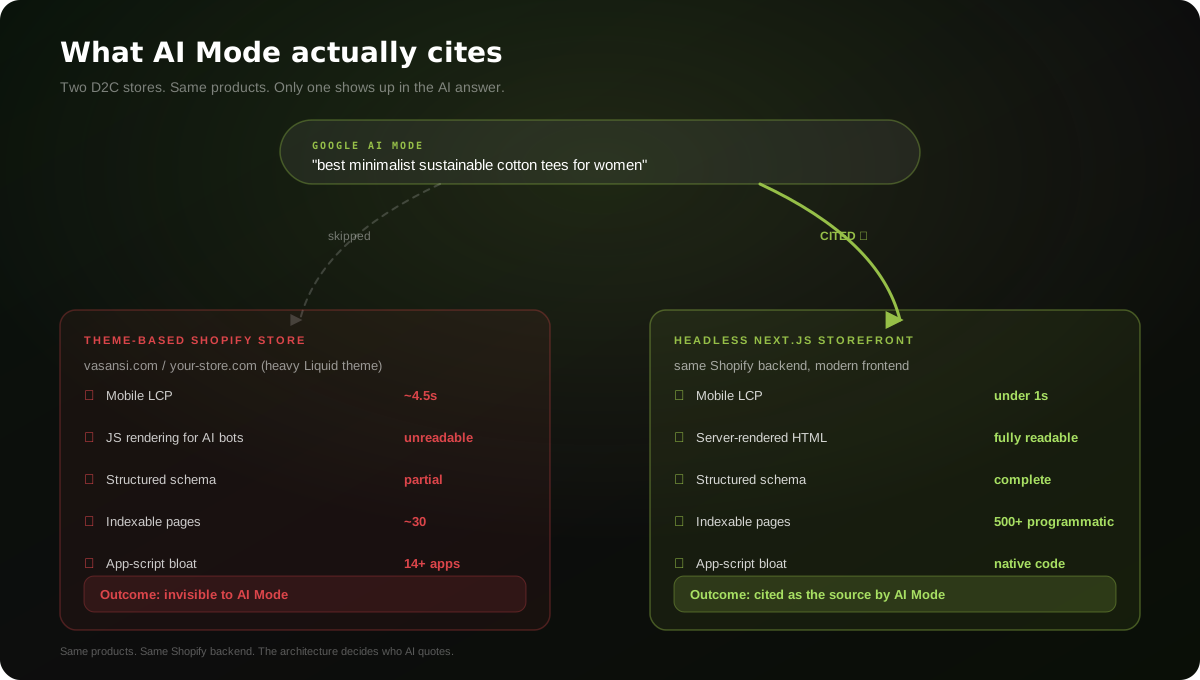
Three things just got brutally harder for theme-based Shopify stores
1. Speed is no longer optional
Google has never published an LCP number you must hit to rank, and anyone who tells you there is one is guessing. What it does publish is narrower, and more useful. Core Web Vitals are used by its ranking systems - Google's page experience documentation, read 22 August 2026 - and a "good" LCP is 2.5 seconds or less, measured at the 75th percentile of page loads - web.dev's LCP reference, read 22 August 2026. Slow down and you get crawled less often - in Google's words, "the limit goes down and Google crawls less" - Google's crawl budget documentation, read 22 August 2026. Most theme stores sit at 4–6 seconds on mobile, especially once a few apps are installed. Not close. A page Google crawls less and renders later is a page it is less likely to cite.
2. AI bots don't reliably run JavaScript
Google's renderer handles JS, but many AI crawlers (GPTBot, ClaudeBot, PerplexityBot, and parts of Google's own AI pipeline) prefer raw HTML. If your theme paints product titles, prices, and content via client-side JavaScript, an AI bot fetching your page sees a near-empty shell. You can't be quoted if you can't be read.
3. Structure is what AI actually quotes
Clean Product schema, FAQ schema, Article schema, consistent attributes, machine-readable metafields - that's what AI lifts. Theme stores treat schema as an afterthought. Headless stores bake it in.
The Google AI update wasn't bad news for everyone. It was bad news for slow, theme-based stores.
The pages already exist. Most AI crawlers cannot read them.
When AI search arrives the instinct is to publish more pages. A theme store already has a URL for every collection and every product it sells; the addresses were never the constraint. What comes back when something requests one of them is.
Vercel and MERJ put the major AI crawlers under measurement and found that none of them execute JavaScript - GPTBot, ClaudeBot and OAI-SearchBot fetch script files and never run them (The rise of the AI crawler, 17 December 2024). Gemini is the exception, because it borrows the Googlebot renderer. So when a theme paints its product grid after load, owning more collection URLs changes nothing. Every one of them answers with a shell.
Server rendering works on the pages you have. The catalogue comes back as HTML in the first response, so the store you already own becomes quotable without publishing a word.
The tactic usually sold as the alternative is to generate a URL for every combination of category, occasion and region, so the long tail has somewhere to land. That is a doorway pattern. We do not build it on our own site and we will not recommend it here.
Why headless wins this new SEO era
Stack the wins from the diagram together and the gap compounds:
- A document measured in kilobytes - our own rebuild ships 3,084 bytes of HTML where the theme shipped 385,680 (curl, 18 August 2026).
- Server-rendered HTML - every word readable by every crawler, AI or otherwise. No "JS pending" failures.
- Complete structured data - Product, FAQ, BreadcrumbList, Article, Organization, Review - the schemas AI quotes.
- Crawlable internal links - every href sits in the HTML response, so the collections and products you already have get discovered instead of waiting behind a script.
- Native code instead of app scripts - no third-party JS bloat slowing the page or polluting the DOM.
- llms.txt + AI-crawler-friendly robots - explicit welcome mat for GPTBot, ClaudeBot, PerplexityBot, Google-Extended.
The 12-month window
AI engines are training on the web they crawl right now. The brands whose data, speed, and structure are clean over the next year will become the cited sources by default - for years. The brands still on slow themes will be invisible in the search box people increasingly use.
This isn't a hypothetical. It's already happening - every day a D2C brand stays on a theme is a day a headless competitor gets cited in their place.
Find out if your store is on the right side of this shift - free.
Get a free auditWhat to do this quarter
- 1Run a PageSpeed Insights on your top 3 pages on mobile. If LCP is over 2.5s, you have a real ranking liability now, not "soon."
- 2Check what AI sees. Disable JavaScript in your browser and load your store. If product titles, prices, and content vanish, AI sees the same thing.
- 3Audit your schema. View source and search for "@type". If you only have Organization and nothing on PDPs, fix it immediately.
- 4Plan the rebuild. If your numbers are bad, optimizing the theme is a patch. A headless rebuild is the durable answer.
See exactly what an AI-ready, headless D2C storefront looks like - and how we build them - on the HeadlineHQ headless agency page.
Frequently asked
Does Google AI Mode replace traditional search rankings?
No - but it changes what success looks like. AI Mode synthesizes answers and cites a handful of sources. Being position #1 in traditional results no longer guarantees a click; being a cited source in AI answers does. Optimizing for both matters, and the requirements for both (speed, server-rendered HTML, structured data) are largely the same.
Will Google AI Overviews crawl my JavaScript-rendered Shopify theme?
Google's own renderer handles JS reasonably well, but other AI crawlers (GPTBot, ClaudeBot, PerplexityBot) don't reliably execute JS. If your theme paints critical content client-side, those engines see a near-empty page - and they're increasingly important. Server-rendered HTML (which headless Next.js gives you) removes that risk.
Why do headless stores rank better than themes for AI search?
Two reasons, and page count is not one of them. The document is far lighter (our own rebuild ships 3,084 bytes of HTML where the theme shipped 385,680 - curl, 18 August 2026), and the content arrives as server-rendered HTML, which matters because most AI crawlers do not execute JavaScript. A theme that paints its catalogue client-side answers them with a shell no matter how many URLs it has. Rendering is the fix, not publishing more pages.