How OutreachOS turns a target niche into booked replies in four stages - discover real companies, enrich and study each one, write a per-prospect email, send and track. The architecture behind why it works in 2026.
Mass outbound sends one message to a list and hopes the list is close enough. Before any recipient gets a vote, the inbox provider takes one - sender reputation, send volume and how earlier recipients engaged feed a throttle that decides whether the message reaches the inbox, the promotions tab, or nowhere. The reflex response across the industry has been "send more." Buy a bigger list. Run twenty A/B tests on subject lines. Spin up another mailbox to scale volume past the throttling.
It hasn't worked. More volume through the same throttle is still the same email, arriving more often.
The real problem isn't volume - it's that mass-personalised email is no longer personal. A mail-merge opener has a shape. "{first_name}, I noticed your company..." is read as a template before it is read as a sentence, and founders, marketing heads and IT directors on the receiving end recognise the pattern rather than the offer. Recognition kills the email, and a subject-line test does not touch it. The signal that a human spent time on this is what gets a reply in 2026 - and at meaningful scale, no human team can produce that signal one message at a time.
We built OutreachOS to produce that signal at scale, automatically. Below is the architecture and the trade-offs.
One thing before you follow that link. This post was published in June 2026 under the name OutreachOS. The site at leadgen.headlinehq.in is presented as HQConnect - that name is in its page title, its comparison table and its pricing, and the word OutreachOS appears nowhere on it. The stages described below are still the steps listed on that page: discover, enrich and study, write the email, then send and track. We have not published anything about how the two names relate, so read what follows as a description of what is at that address rather than of a name. Read 23 August 2026.
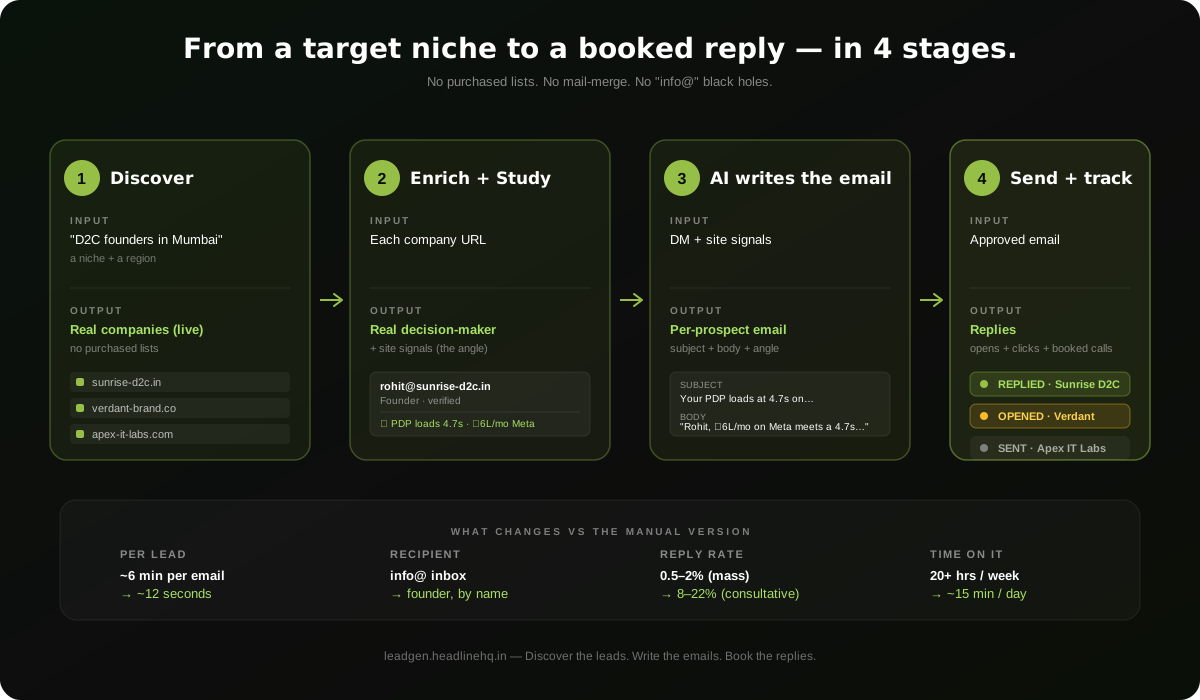
The four stages - and why each one is necessary
Most cold-outreach tools fix one stage and ignore the rest. Apollo gives you a list. Lemlist gives you a sequence. Instantly gives you sending infrastructure. They're useful pieces, but the bottleneck moves: better lists hit the same templates, better sequences hit the same generic openers, better deliverability hits the same dead replies.
OutreachOS treats the whole pipeline as one system. Each of the four stages produces a specific, named output that the next stage consumes - and the quality at each stage is what makes the final number (replies) move.
1. Discover - real companies from a live web search
You give the system one input: a target niche plus a region. ("D2C founders in Mumbai." "SaaS companies in the US below 50 employees." "IT services firms in Delhi NCR with a public engineering blog.") It then searches the live web for companies that actually match those criteria right now.
Why this matters: a purchased B2B list is a snapshot of a moment that has already passed, and nothing in it re-verifies itself. Companies on it rebrand, change tooling, move the decision-maker, or go quiet, and the file never finds out. Live discovery means every company entering the pipeline is currently active, currently in market, currently reachable.
2. Enrich + Study - the actual decision-maker and the real opening
For each discovered company, the system does two things in parallel. First, it locates the verified email of the actual decision-maker - founder for small companies, marketing head or department director for mid-market, CTO or IT director for software buys. Not the generic `info@` inbox where pitches die. Second, it studies the company's public site for usable signals: page speed, design issues, ad spend visibility, missing pages, tech stack tells, recent product launches, leadership messaging.
That second part is where most "personalisation" tools quietly fail. They treat personalisation as "swap in the company name" - which a recipient sees through immediately. Real personalisation requires noticing something specific that the recipient knows about their own business: a slow PDP they've been meaning to fix, a competitor that just launched, a gap that's been on their roadmap for six months.
Generic personalisation reads like a robot trying to be polite. Real personalisation reads like a colleague noticed something. Only one of them earns a reply.
3. AI writes the email - per-prospect, not per-template
The third stage produces a one-of-a-kind email for each prospect: subject line, opening line, body, soft CTA. The opening references the specific signal found in stage 2. The body explains the angle in consultative language. There's no template, no mail-merge fallback, no shared body across recipients.
The cost of doing this per-prospect used to be prohibitive - a senior outbound SDR researches one prospect at a time and gets through a list slowly. AI does the same research and drafting for every prospect on the list, while preserving the consultative tone. That cost compression is what makes the model work; below a certain per-email cost, the maths of personalised outreach simply doesn't survive.
4. Send + track - with the receipts visible
The last stage handles deliverability (warm-up, daily caps, sending-domain rotation), pushes the approved emails out, and tracks what happens - opens, clicks, replies, booked calls. The pipeline view colour-codes each lead so you always know the stage: sent / opened / replied. Auto-detected replies pause future follow-ups in that thread, so no one ever gets the "polite follow-up" after they've already responded.
Built-in follow-up sequences are designed conservatively - typically 2–3 follow-ups spaced 4–7 days apart - because at the per-prospect quality level OutreachOS produces, blasting follow-ups is the wrong instinct. Most replies arrive on the first send or the first follow-up; anything beyond that is a small tail you don't need.
What changes versus running this manually
The numbers, side-by-side:
- Per email: hand-researched one at a time to drafted for every prospect on the list at once.
- Recipient: `info@` shared inbox → founder or director by verified name. Reply rates scale roughly with the seniority of the inbox the email lands in.
- Reply rate: we have not published one, because we have not measured one on an instrument we could show you. What moves it is the quality of the input the recipient sees, not the sending tool.
- Founder time: prospecting, researching and writing every message, to approving sends and replying to interested leads.
The architectural choices that matter
Unlimited parallel campaigns with separate identities
A real outbound operation rarely lives in a single niche. An agency might be selling design to D2C brands, SaaS audits to ARR-stage startups, and headless rebuilds to founders past Series A - all at the same time. OutreachOS supports unlimited parallel campaigns, each with its own sending identity, niche, angle, and tone. The decision-maker logic and the writer engine retune per campaign without leaking content across them.
Live discovery, not list buying
The discovery stage hits the web on every run. There is no purchased contact list, no licensed database. That sounds like a small architectural detail; it's actually the difference between consistent reply rates and a slow degradation as a static list ages. Every campaign starts on a fresh, in-market segment.
Smart, restraint-first follow-ups
Most outbound tools default to aggressive follow-up cadences because, with low base reply rates, the only way to extract any reply at all is to send more. At OutreachOS's base quality, follow-ups can be sparse - 2 or 3 max - and the model still produces a useful reply curve, without the brand damage of looking like a chaser.
Where it fits - agencies, IT firms, SaaS, services
OutreachOS is industry-agnostic by design, but it pays off fastest for businesses where:
- Average customer value is high enough that a handful of replies on a focused list is material (typically anywhere with a contract value above ₹50,000 / $600 per customer).
- The buyer is a named person, not a department - founder, owner, director, head of marketing, CTO.
- The service can be summarised in one specific outcome the buyer recognises (faster site, lower RTO, cheaper compliance, more pipeline, etc.).
- The founder or BD lead has been spending more than 5 hours a week on outbound personally, with diminishing returns.
Most B2B service businesses - agencies, IT firms, SaaS at all stages, consultancies, specialist studios - fit that shape. The system is not for businesses selling commodity products on price; it is for businesses where the pitch is consultative and the buyer is a person.
How OutreachOS sits next to the rest of HeadlineHQ
OutreachOS is part of a small set of operating-pain apps under HeadlineHQ. Each one was built because we kept watching the same line item drag on our clients' or our own P&L:
- LineDrop - get a season's catalog into Shopify with the images already attached.
- Fig2Shop - get a Figma design into Shopify as an editable section in 4 clicks.
- ProfitOS - get yesterday's real, RTO-adjusted profit on WhatsApp every morning.
- OutreachOS - run the outbound loop above without a person sitting inside it. The site at that address is presented as HQConnect.
They share a tone: every app exists because a human task in the operating loop is being done worse than software can do it, and the alternative - hiring more people, or doing it manually for another quarter - costs more than anyone's ledger admits.
See it on a real niche. The site you land on is presented as HQConnect, and its free tier is listed there as one campaign and 15 leads a month - enough to judge the output before paying anything. Read 23 August 2026.
Open leadgen.headlinehq.inBottom line
Cold email isn't dead. The mass version of it is - and "send more, faster" is the wrong response to a problem that's actually about input quality. The shift that works is producing one good email at a time, at scale, with the kind of context a real human researcher would have produced if you could afford one researcher per prospect.
OutreachOS is built to be that researcher, plus the writer, plus the sender, plus the tracker - running in a loop while you do the part only you can: take the calls that come back.
Frequently asked
The link says OutreachOS and the site says HQConnect. Which one am I looking at?
Both names are on this site, and we are not going to guess in public at what that means. This post was published in June 2026 under the name OutreachOS. The site at leadgen.headlinehq.in is presented as HQConnect - that name is in its page title, its comparison table and its pricing, and the word OutreachOS appears nowhere on it. We have not published anything about how the two names relate. What you can check in ten seconds is the address itself: open it, and the stages described in this post are the steps listed on that page - discover, enrich and study, write the email, then send and track. Read 23 August 2026.
How is OutreachOS different from Apollo, Lemlist, or Instantly?
Those tools each fix one stage. Apollo gives you a contact list. Lemlist gives you a sequence builder. Instantly gives you sending infrastructure. OutreachOS treats the whole pipeline as one system - live discovery (no purchased lists), per-prospect site research, AI-written email per prospect (not per template), and send/track in one loop. The point is not to send more, it is to make each individual email worth a reply. We have not published a number for how much that changes the reply rate, because we have not measured one on an instrument we could show you.
What kind of reply rate should I realistically expect?
We are not going to give you a number. We have not measured a reply rate on an instrument we could show you, and neither has anyone else selling cold email software who quotes you one. What separates a good campaign from a bad one is the quality of the input the recipient sees, not the sending tool.
Will my sending domain get burned by spam complaints?
Deliverability is built into the pipeline: domain warm-up, daily send caps, sending-domain rotation if you connect multiple, and conservative follow-up cadences (typically 2–3 max). The whole product is designed for consultative outreach - emails that look like a human spent time on them, not blasts. Recipients who report spam usually report templates and mail-merge fields; per-prospect emails very rarely trigger that.
How long until I see the first replies?
Not on a schedule we are willing to sell you. We have not measured a reply curve on an instrument we could show you, and we are not going to borrow someone else's. Two things do shape it, and both are visible to you. A tight niche with a concrete service angle gets read sooner than a broad list. A new sending domain cannot move fast at all - warm-up and daily send caps hold the volume down on purpose, so an early campaign leaves as a trickle. Run it anyway. The first campaign is the measurement, and the curve it gives you is your number.
Is OutreachOS only for tech businesses?
No. It works for any B2B service business where the buyer is a named person (founder, owner, director, marketing head, CTO) and the contract value clears roughly ₹50,000 / $600 per customer. That covers agencies, IT firms, SaaS, consultancies, specialist studios, and most "we sell expertise" businesses. It is not for commodity products where the buyer is anonymous or the price is the only differentiator.