Features get attention. Use cases earn retention. Why most Shopify app launches fade once the newness wears off - and how to build the ones that last.
Every day, new Shopify apps land on the App Store. More categories. More features. More AI bolted onto everything. More options for merchants.
The reflex reaction in our circles is the same: is anyone going to use all of this? But "are too many apps being launched?" is the wrong question. The right one is sharper:
How many of them are actually solving something merchants care about?
What merchants actually want (it's a short list)
Shopify merchants don't need another tool just because it exists. They need apps that move one of five levers - and only those:
- Increase revenue
- Save time
- Reduce manual work
- Improve customer experience
- Make daily operations easier
Anything that doesn't move one of those five is decoration. And decoration uninstalls in a week.
Features get attention. Use cases earn retention.
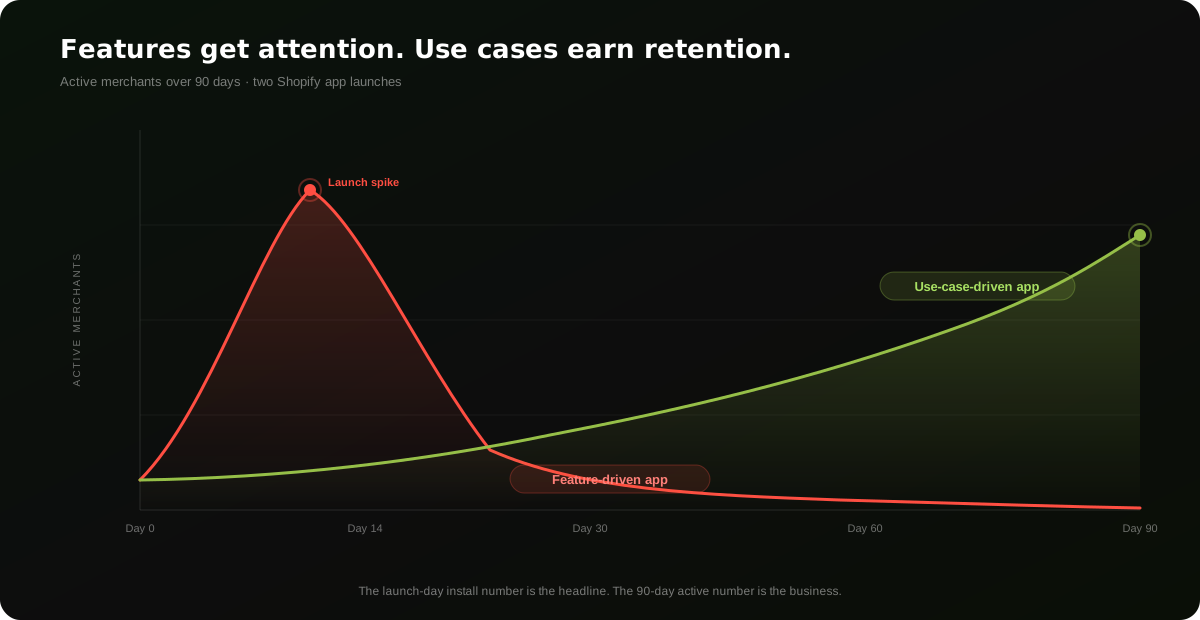
The shape above is what most app teams won't say out loud. A feature-driven launch spikes installs while the launch is still the story - App Store newness, a viral tweet, a launch list. Then the curve falls. Users open it once, see the feature, and forget the app exists.
A use-case-driven app starts slower - fewer installs in week one, less excitement on launch day. But every install was earned by a real problem the merchant was trying to solve. Those installs stay. Those merchants invite teammates. Those merchants pay year two.
The shift Shopify app builders need to make
Launching fast is good. Staying useful is better. The Shopify ecosystem will keep growing. The apps that last won't be the ones with the longest feature list. They'll be the ones closest to real merchant problems.
How we think about this at HeadlineHQ
We build Shopify apps for our D2C clients - and we've shipped two of our own: LineDrop and ProfitOS. Both started from one quiet observation we couldn't unsee:
LineDrop
LineDrop wasn't built because we wanted to make another catalog importer. It was built because every Indian D2C client we worked with spent the run-up to a launch copying SKUs into Shopify's CSV format and pasting image URLs at midnight. The feature is "import from Excel." The use case is "nobody re-keys the linesheet, and nobody pastes another image URL." That's a different conversation.
ProfitOS
ProfitOS wasn't built because we wanted another analytics dashboard. It was built because founders kept telling us they tracked revenue, not real profit - and they discovered the RTO truth at month-end, far too late to act. The feature is "daily WhatsApp brief." The use case is "know yesterday's actual profit before your second cup of chai."
Both apps will eventually have more features. Neither will ship anything that doesn't tighten the use case.
Building a Shopify app - or thinking about one? We can help shape it around the right use case.
Talk to usBottom line
More apps will keep launching. Most will get a week of attention and then go quiet. The few that last will be the ones close to real merchant work - the ones a founder can describe in one sentence with a verb that matters: increases, saves, reduces, improves, simplifies.
See where this thinking lands as actual products: LineDrop (linesheet → Shopify, images matched by SKU code) and ProfitOS (real, RTO-adjusted profit on WhatsApp every morning).
Frequently asked
What separates a Shopify app that lasts from one that doesn't?
Apps that move one of the five merchant outcomes - revenue, time saved, less manual work, better customer experience, or easier operations - get retained. Apps that just have features get installed, used once, and uninstalled. The difference shows up in 30-day and 90-day active-merchant numbers, not in launch-day installs.
How does HeadlineHQ decide what to build?
Every app we ship starts from a problem we've watched real D2C clients struggle with for months. LineDrop came from watching teams lose days per season to manual catalog entry. ProfitOS came from watching founders discover their real, RTO-adjusted profit only at month-end. If we can't describe the use case in one sentence with a verb (saves, reduces, increases), we don't build it.
Are AI-powered Shopify apps automatically more useful?
Only if the AI is solving a real merchant problem. AI bolted onto a generic feature is still decoration - and AI decoration uninstalls just as fast. AI that genuinely automates something painful (catalog cleanup, RTO verification, image processing, daily profit reporting) earns the retention. The AI label is not the differentiator; the underlying use case is.