Shopify connecting with ChatGPT and Claude isn't just an AI update - it's a warning. AI is only as good as the data it can read, and most D2C catalogs are a mess. Here's why store hygiene now decides who wins.
Shopify connecting with ChatGPT and Claude is not just another AI update. For D2C brands, it's a warning.
Soon, your store won't only be operated from the Shopify Admin. It will be operated through prompts.
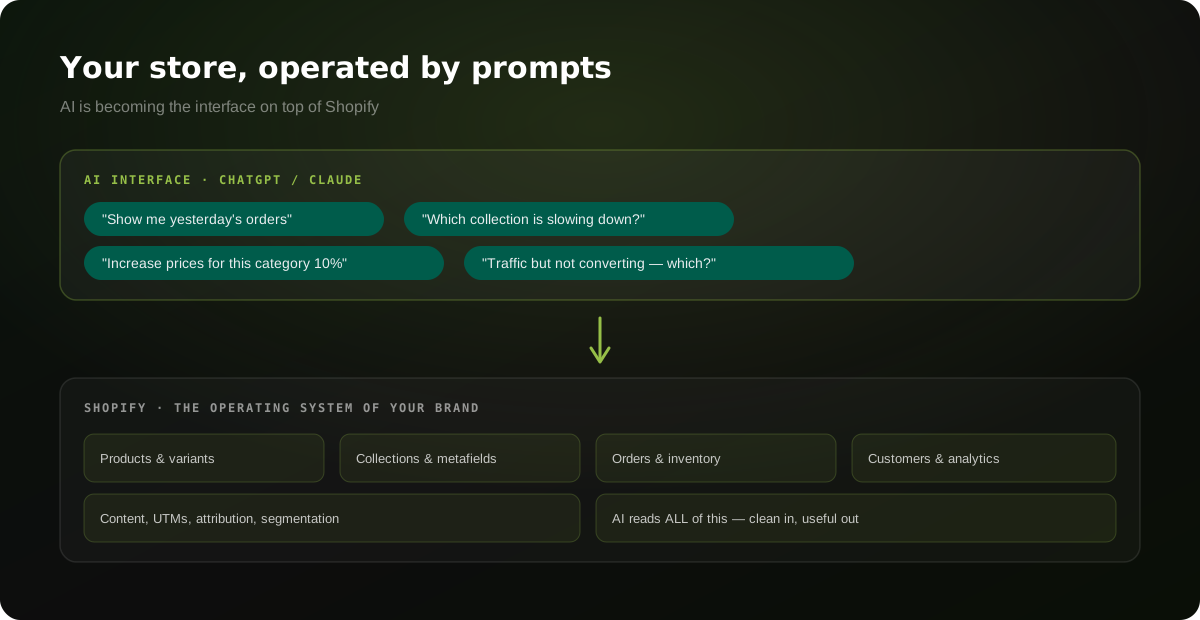
The day-to-day will sound like this:
- "Show me yesterday's orders."
- "Which collection is slowing down?"
- "Increase prices for this category by 10%."
- "Which products are getting traffic but not converting?"
The thing connecting your store to ChatGPT and Claude is called MCP
The coverage of all this never names the thing doing the work. It is the Model Context Protocol - MCP for short. modelcontextprotocol.io calls it "an open-source standard for connecting AI applications to external systems", and names Claude and ChatGPT among the clients that support it. The current revision of that specification carries the date 28 July 2026. MCP is a standard, not a product, and it is not Shopify's.
Shopify runs MCP servers on top of that standard. Your store already has one, at {shop}.myshopify.com/api/mcp, and Shopify's developer docs list the tools it exposes: search_catalog, lookup_catalog, get_product, search_shop_policies_and_faqs, get_cart and update_cart. A second server sits outside your store altogether. That one is the Global Catalog, at catalog.shopify.com/api/ucp/mcp. Shopify's docs describe it as letting AI agents "search and discover products across the entire Shopify ecosystem, helping buyers find products from multiple merchants". Shopify does not publish which merchants' products appear in it. Treat anyone who claims to know as guessing.
You never touch a server yourself. You install a connector, and Shopify's Help Centre names four:
- The Shopify app for ChatGPT
- The Shopify app for Claude
- The Shopify app for Perplexity
- The Shopify CLI connector
Two lines on that Help Centre page matter more than the rest. You connect one store at a time, even if your stores sit in the same organisation. And if the AI tool makes an incorrect change, "you're responsible" - Shopify's words, not mine. That is what write access means. update_cart does not read your store. It changes it.
The MCP cart tools lose support on 31 August 2026
This is the part the ranking articles have not caught up with. Shopify's developer changelog carries an entry dated 24 June 2026, tagged Action Required. Its title: Storefront MCP cart tools are being deprecated in favour of UCP Cart MCP. In plain terms: get_cart and update_cart on {shop}.myshopify.com/api/mcp are deprecated, and the deprecated tools will be maintained until 31 August 2026.
The replacement is the Cart MCP set - create_cart, get_cart, update_cart and cancel_cart - at {shop-domain}/api/ucp/mcp. UCP is the Universal Commerce Protocol; ucp.dev holds the specification. Shopify Engineering, 11 January 2026: "We co-developed UCP with Google to create an open standard for AI agents to connect and transact with any merchant."
If you use one of the connectors from Shopify's list, you are not calling those endpoints yourself. If somebody built you a custom AI agent that adds to cart on a shopper's behalf, ask them which endpoint it calls.
You did not opt into MCP. Your Liquid storefront already did.
Most founders read this as a decision waiting in a future sprint - an app to install, a budget line to defend. On Liquid, it is already behind you. Shopify's developer changelog, 5 August 2026, is plain about the merchant's side of WebMCP: "There's nothing to install or configure." The proposed standard lets a page register tools with the browser, so an agent uses your storefront instead of reading page code and faking clicks. Alongside the MCP servers, those tools cover your catalog, your cart, your checkout, and your shop policies and FAQs.
So the question is not whether to join. It is what those tools hand over. A thin title, a blank attribute, a description written to fill the space under a photo - the agent passes that to a shopper who never opens your page. Your catalog is being read by machines already, not next quarter.
It sounds convenient. And it is. But here's the real problem most Indian D2C brands are not ready for: their backend data is a mess.
The mess that's about to become an AI problem
Walk into the average D2C Shopify backend and you'll find:
- Product titles that are inconsistent
- Collections that aren't structured properly
- Attributes that are missing
- Inventory that isn't clean
- Product descriptions that are generic
- Metafields that are ignored
- UTMs that are broken
- Analytics that's half-connected
- Customer data that isn't properly segmented
Until now, this was an internal operational problem - annoying, but survivable. Tomorrow, it becomes an AI problem.
AI is only as good as the data it can read. If your catalog is messy, AI will give you messy answers.
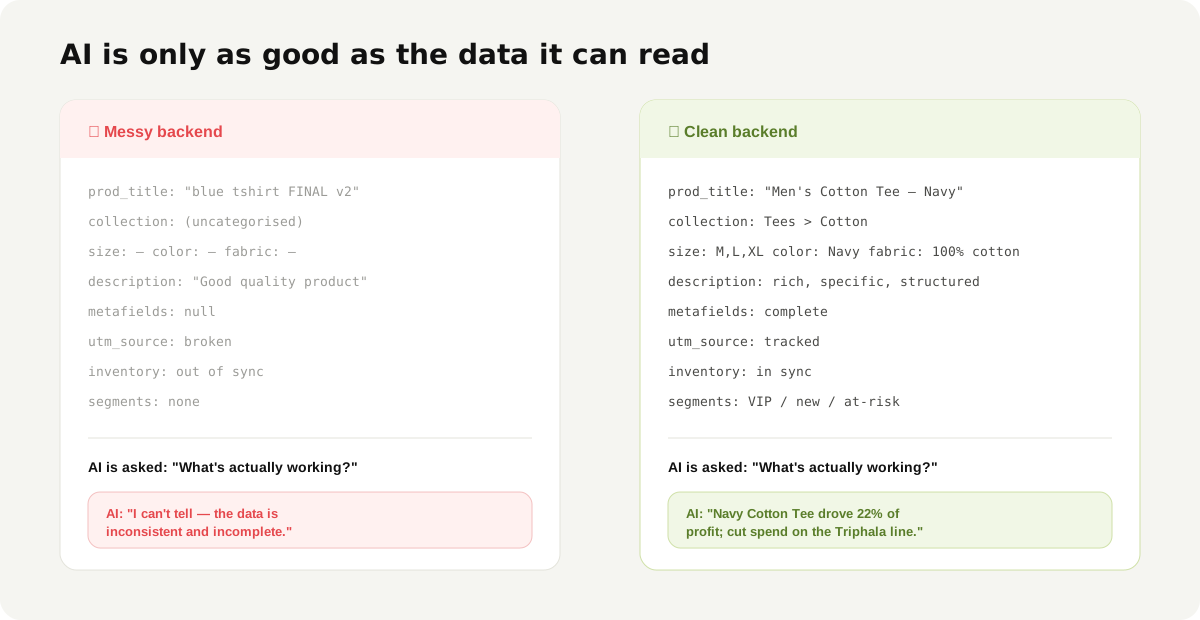
If your product data is weak, AI won't understand your store properly. If your collections are badly structured, AI will struggle to identify what is actually working. The interface gets smarter; the foundation does not - and the gap shows up instantly.
The next phase of D2C isn't ads. It's systems.
For years, growth meant more ad spend. The next phase will be won on something less glamorous and far more durable: clean, structured systems.
- Clean product data
- Clean analytics
- Clean catalog structure
- Clean customer segmentation
- Clean content architecture
- Clean website foundations
Most brands still treat Shopify like a place to upload products. But Shopify is quietly becoming the operating system of the brand - and AI is becoming the interface sitting on top of that operating system. That means your store hygiene matters more than it ever has.
The brands that win won't be the ones using AI the most
Here's the part most people get backwards. The winners of this shift will not be the brands that use AI the most. They'll be the ones whose data, website, catalog, and content are clean enough for AI to actually help them.
AI will not fix operational laziness. It will expose it faster.
How to get your store AI-ready
This is exactly the work we do at HeadlineHQ - turning messy D2C stores into clean, structured, AI-ready foundations:
- Clean catalog structure - consistent titles, proper collections, complete attributes and metafields. Our LineDrop importer enforces clean, structured product data from the start.
- Clean analytics & attribution - server-side tracking, fixed UTMs, and ProfitOS for real, RTO-adjusted profit data instead of half-connected dashboards.
- Clean website foundations - a headless storefront with structured, machine-readable content and schema, so both Google and AI engines understand your store.
- Clean segmentation - automated customer tagging so your data actually means something.
Find out how AI-ready your store really is - free.
Get a free auditThe AI interface is coming whether your store is ready or not. The brands that clean their foundations now will get an AI that genuinely helps them run the business. The ones that don't will get a faster, sharper mirror held up to the mess. Choose which one you want to be - while you still have the head start.
Frequently asked
What does it mean for Shopify to connect with ChatGPT and Claude?
It means your store can increasingly be queried and operated through natural-language prompts - asking an AI about orders, collections, pricing, or performance instead of clicking through the admin. The AI reads your Shopify data to answer, so the quality of that data determines the quality of the answers.
Why does clean catalog data matter for AI?
AI is only as good as the data it can read. Inconsistent titles, missing attributes, unstructured collections, broken UTMs, and ignored metafields all make it impossible for AI to understand what's actually happening in your store - so it returns vague or wrong answers. Clean, structured data produces specific, useful ones.
How do I make my Shopify store AI-ready?
Clean and structure the foundations: consistent product data and titles, properly organised collections, complete attributes and metafields, fixed analytics and UTMs, customer segmentation, and machine-readable content. HeadlineHQ does this as part of headless rebuilds and catalog/operations automation - start with a free audit.
Do I need to install anything to connect my Shopify store to ChatGPT or Claude?
Yes - a connector. Shopify's Help Centre names four: the Shopify app for ChatGPT, the Shopify app for Claude, the Shopify app for Perplexity, and the Shopify CLI connector. You connect one store at a time, even if the stores share an organisation. The connection runs on MCP, the Model Context Protocol. Some of its tools write to your store rather than only reading from it, and if an AI tool makes an incorrect change, Shopify's Help Centre says you're responsible. The App Store listing called MCP is a third-party app from Gaia Suite, not Shopify's own.